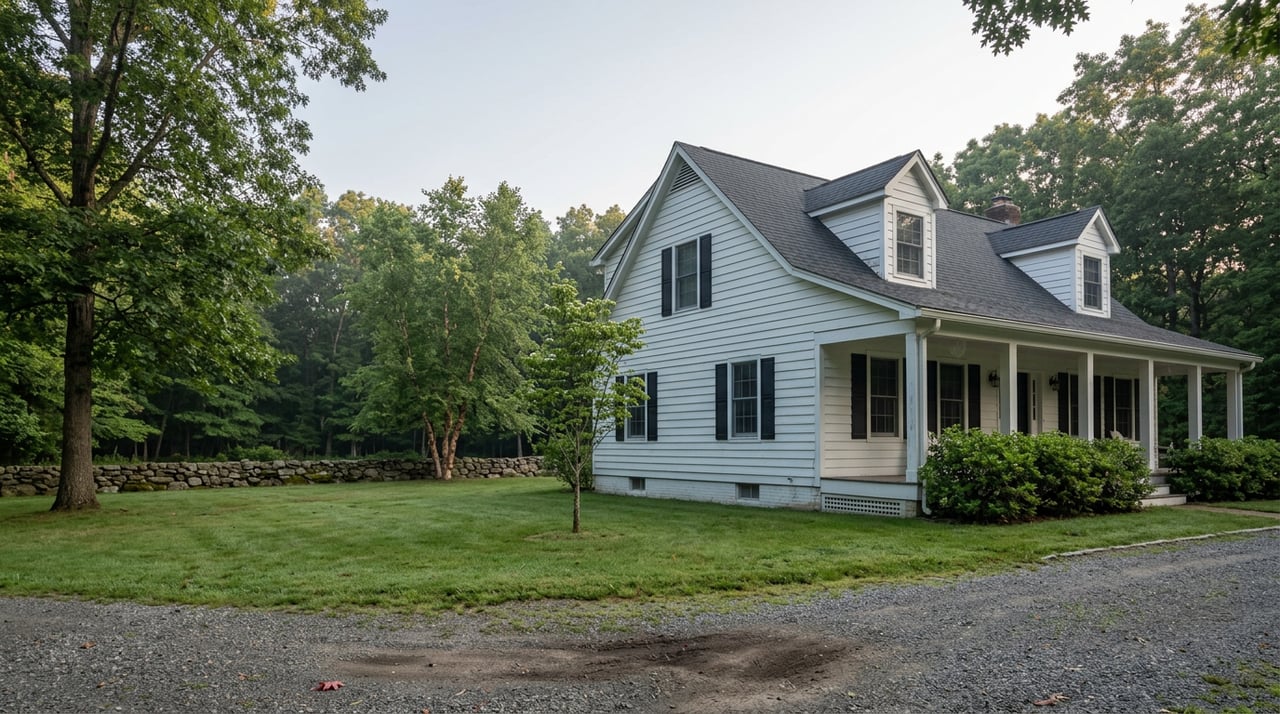
Two houses in New Fairfield can list at the same price, sit a half mile apart, and cost their owners very different amounts to hold every year. The gap has nothing to do with square footage or the age of the roof. It comes down to a line on the tax bill that never shows up in a portal search: whether the address falls inside one of the town's three special tax districts.
If you have been comparing New Fairfield to other towns around Candlewood Lake using the median price alone, you are missing the number that actually separates one property from another. Here is what that number is, where it comes from, and how to find out before you fall for a house.
The town bill is only half the story for some owners
Every property in New Fairfield pays into the same pot first. The town's Board of Finance set the mill rate at 26.33 for the 2025-26 fiscal year after voters approved the town and school budgets in a close referendum, according to reporting at the time that quoted First Selectwoman Melissa Lindsey. The town's own tax office now lists the current rate at 27.54 mills, a jump of roughly 4.6 percent. On a home assessed at $400,000, that increase alone adds close to $500 a year before anything else changes.
That's the baseline. Every homeowner in town pays it. But three named pockets of New Fairfield layer a second, entirely separate tax bill on top of it: Candlewood Isle, Timber Trails, and Candlewood Hills. These are not homeowners associations in the voluntary sense. They are special taxing districts, formed under Connecticut's statute for special tax districts, with their own elected boards and their own authority to assess property owners inside their boundaries.
What these districts actually are
The Tax District of Candlewood Isle is the clearest example on record. It manages and maintains the roads, security, and shared facilities on the Isle, operating under Connecticut General Statutes covering special tax districts. A related but separate entity, the Candlewood Isle Association, is the Connecticut corporation that actually owns the clubhouse, the post office building, the roads, and the open space. The Association leases all of that property to the Tax District, which is the body with the legal power to bill residents. Every property owner on the Isle is a shareholder in the Association and gets one vote per property, but the tax bill itself comes from the District.
Timber Trails works on a similar model, except its boundary crosses the line between New Fairfield and Sherman, which means a home addressed in one town can sit inside a taxing authority whose president and office are associated with the neighboring one. Candlewood Hills is the third district the town lists on its own tax collector page, structured the same way as the other two.
None of this shows up when you filter a home search by town, price, and bedroom count. It only appears once you know to ask, or once you get far enough into a transaction that someone hands you the actual tax bill.
What that means for the number you've already seen
New Fairfield's median numbers have moved around depending on which month and which source you're looking at, and that instability is itself a clue that the median alone isn't the tool you need. Listings tracked in January 2026 put the median sale price at $679,900. By May 2026, the median list price for the town had climbed to roughly $694,000. Looking at the trailing twelve months through mid-2026, the average sale price across New Fairfield came in around $642,477, up about 8 percent from the prior twelve-month period.
Those are useful numbers for sizing up the town against its neighbors. They are close to useless for comparing one specific address to another inside New Fairfield, because none of them separate district properties from non-district ones. A $650,000 colonial off Route 37 and a $650,000 lakefront cottage on Candlewood Isle can carry the identical town mill rate and a completely different total tax bill once the district assessment gets added in. The portal median treats them as the same data point. They are not.
Comparing the two situations
| Non-district New Fairfield home | Home inside Candlewood Isle, Timber Trails, or Candlewood Hills | |
|---|---|---|
| Town tax | Town mill rate applies (27.54 mills currently) | Same town mill rate applies |
| Second assessment | None | Separate annual bill from the district's own tax collector |
| What it funds | N/A | Private road maintenance, security or a guardhouse, and shared amenities like a clubhouse or lake access points |
| Who sets the rate | New Fairfield's Board of Finance | The district's own elected board, independent of the town budget cycle |
| Where to find it | Town assessor's office | District's own tax collector, listed separately from the town |
The right side of that table is where a lot of the lifestyle appeal of New Fairfield actually lives. Guardhouses, private beaches, and maintained association roads are part of what makes lake-adjacent living in this town different from a standard suburban lot. The tradeoff is a governance structure most buyers from outside Connecticut have never encountered, layered on top of a town tax rate that has already been climbing.
What to check before you write an offer
If you're looking at anything near Candlewood Lake in New Fairfield, treat the district question the same way you'd treat a well or septic question anywhere else in the Hudson Valley or western Connecticut. It's not a dealbreaker. It's a fact you want in hand before you commit to a number.
- Ask directly whether the address sits inside Candlewood Isle, Timber Trails, or Candlewood Hills. The town's own tax collector page lists all three districts, and each has its own contact for billing questions.
- Request the most recent annual assessment notice from the seller, not just the town tax bill. The two are billed and collected separately.
- Confirm which entity actually holds title to shared amenities like a clubhouse, private beach, or marina, since in at least one district the taxing authority and the property-owning association are two different organizations with a lease between them.
- If the property sits near a town line, like parts of Timber Trails do, ask which district's boundary the specific parcel falls inside rather than assuming it follows the mailing address.
- Factor the district assessment into your monthly budget the same way you would flood insurance or a homeowners association fee anywhere else. It's recurring, it's billed separately, and it doesn't show up in a standard mortgage pre-approval unless you tell your lender about it.
None of this requires walking away from a lake-access neighborhood. It requires knowing, before you're at the closing table, whether you're signing up for one tax bill or two.
FAQ
Does every home in New Fairfield fall inside a special tax district? No. The three named districts, Candlewood Isle, Timber Trails, and Candlewood Hills, cover specific neighborhoods, mostly clustered around lake access. Most of the town's housing stock pays only the town-wide mill rate.
Are these fees the same as a typical homeowners association due? Not exactly. A voluntary HOA collects dues through a private contract. These districts are units of local government created under Connecticut's special tax district statute, with the legal authority to levy and collect a tax, not just a membership fee.
Can I find out if a specific address is in a district before I tour it? Yes. The town's tax collector maintains a list of the special districts operating within New Fairfield, and each district has its own office you can contact directly to confirm whether a parcel is inside its boundary.
If you're comparing New Fairfield to other towns around the lake, or trying to figure out what a specific address will actually cost to hold long term, that's exactly the kind of question worth running past someone who works this market every week. The Price Team can pull the district status on a specific listing before you write an offer, not after. Get access to our listings to start looking with the full picture in hand.